|
Key points at a glance
|
When was the last time you thought about your type plate? Presumably when the drawing was approved. Never again after that. The plate costs just a few euros, sits somewhere on the housing and doesn’t feature in any risk assessment. Until, twelve years later, a service technician stands in front of the plant and can no longer make out the serial number.
That is precisely when it becomes clear whether anyone had put any thought into the specification. An aluminium nameplate looks robust. However, it is not the base material that determines whether it actually is. It is determined by the way the information is applied to or embedded in the metal.
The requirement is for it to be permanent, not ‘valid until acceptance’
The Machinery Directive requires manufacturers to affix the company name and address, machine designation, CE marking, type designation, serial number (where applicable) and year of manufacture to the machine in a manner that is recognisable, clearly legible and permanent. The EU Machinery Regulation 2023/1230 comes into force on 20 January 2027 and incorporates these essential requirements into its new Annex III.
In this context, ‘permanent’ is not a flexible term. Many machines remain in operation for 20 years or more. The type plate must withstand this period, including all cleaning cycles, temperature fluctuations and maintenance operations. A plate that fades after five years meets the requirement on the day of delivery. During operation, it will eventually cease to meet it.
Where type plates fail in practice
These failures almost always follow the same patterns.
-
Cleaning agents and cooling lubricants dissolve the printed ink until numbers and barcodes become illegible.
-
UV radiation causes lettering to fade within a few years when used outdoors.
-
Tools, gloves and high-pressure washers mechanically wear away the printed layer.
-
Heat near drives, pumps or furnaces causes inks and paints to age more quickly.
The tricky thing is that the plate itself remains intact. The aluminium holds up; only the information on it disappears. In the spare parts business, during a recall or in a liability dispute, it is precisely the data that uniquely identifies the machine that is then missing.
Aluminium type plate: paint on the metal or in the metal?
This is where the real difference lies between nameplates that look identical when new. With many printing techniques, the ink sits as a layer on the metal substrate. It is therefore subject to wear from anything that comes into contact with the surface.
With the anodising process using sub-anodic printing, however, the colour is embedded within the pores of the aluminium itself. A crystal-clear anodised layer then seals the lettering. Think of it like a tattoo: the information lies beneath the skin rather than on top of it. This layer is harder than granite. Scratches, solvents and UV light therefore cannot reach the ink in the first place.
In this way, our anodised type and industrial plates achieve a high level of resistance to mechanical, thermal and chemical stresses in accordance with DIN 30645. We tailor the shape, size, material thickness and surface quality to your specific application.
Five questions you should clarify before placing your order
A good type plate doesn’t start with the supplier. It starts with your specifications.
1. What substances will the plate be exposed to? Specify particular cleaning agents, oils or chemicals rather than a general ‘industrial environment’.
2. What are the temperature and UV exposure levels at the installation site? Also consider downtime, storage and transport.
3. What material thickness and fastening method are suitable? Rivets, screws or adhesive bonding depend on the substrate and vibration levels.
4. What regulations apply in your sector? In the automotive industry, for example, the Federal Motor Transport Authority’s regulations for type plates play a role.
5. Does the manufacturer meet the requirements of your supply chain? Look for robust certifications to ISO 9001, IATF 16949 and TISAX.
If you overlook these points, you’ll end up with a standard plate. That’s cheap – until you have to replace it.
When an anodised plate is not the first choice
Not every marking requires aluminium. If you are applying variable data directly during production and need to mark large quantities flexibly, laser-markable films are often the more cost-effective option. The aluminium type plate really comes into its own where extreme stress, a long service life and a high-quality appearance are required. Typical examples include pumps, drives, construction machinery and equipment used outdoors.
More than just mandatory information: the plate as a gateway to data
A QR code on the nameplate links the machine to the operating instructions, spare parts catalogue or service history. In future, the Machinery Regulations will permit operating instructions to be made available digitally. This makes the code a direct route to the documentation. However, this only works as long as the code remains legible. A scratched code is a dead link.
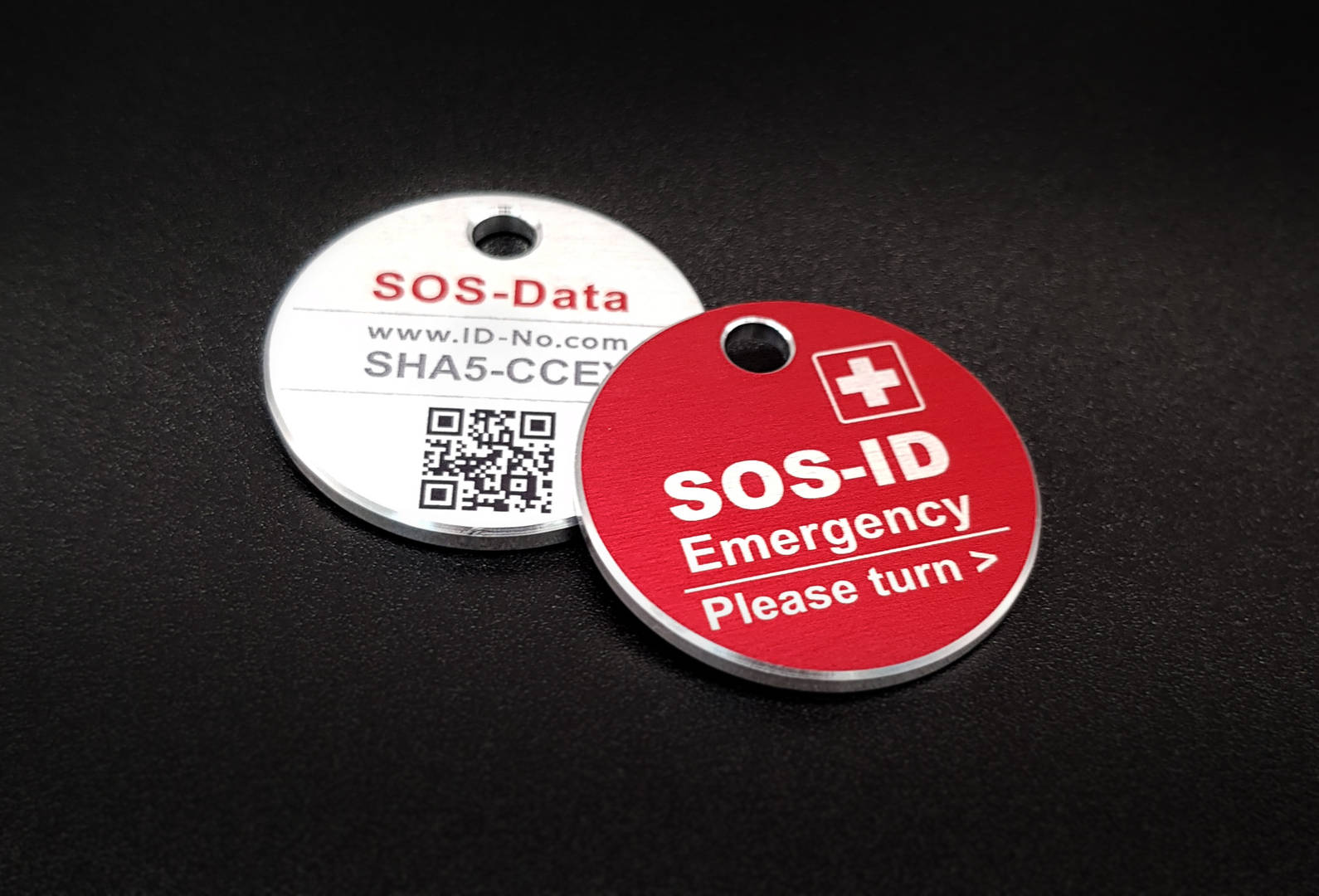
This is precisely where the marking beneath the anodised layer pays off. A real-world example is an SOS-ID chip with a QR code, which provides vital information in an emergency. Digital type plates, which combine physical marking with digital information, demonstrate just how far this approach can go.
Frequently asked questions about aluminium nameplates
How long does an aluminium nameplate last?
An anodised aluminium nameplate with under-anodise printing generally remains legible throughout a machine’s entire service life, as the ink lies beneath the protective anodised layer. In contrast, with printed plates, the print layer limits their durability, depending on the chemicals, UV radiation and abrasion at the site of use.
What does the Machinery Regulations stipulate regarding the nameplate?
Mandatory information such as the manufacturer’s name and address, machine designation, CE marking, type designation, and, where applicable, the serial number and year of manufacture must be clearly identifiable, legible and permanently affixed to the machine. The EU Machinery Regulation 2023/1230 comes into force on 20 January 2027 and replaces the Machinery Directive 2006/42/EC.
What is the difference between printed and anodised nameplates?
With printed plates, the ink sits on the surface; with anodised plates featuring under-anodic printing, the ink is embedded in the pores of the aluminium beneath a crystal-clear protective layer. This means that scratches, solvents and UV light cannot damage the marking.
Can an aluminium nameplate feature a QR code?
Yes, QR codes, serial numbers and logos can be individually incorporated into anodised nameplates. As the code lies beneath the anodised layer, it remains scannable even after years of heavy use.
Which nameplates are suitable for environments exposed to chemicals?
For environments containing cleaning agents, oils or cooling lubricants, anodised aluminium nameplates are suitable, as the lettering is protected beneath the anodised layer. Please specify the exact substances in the specifications so that the manufacturer can select the appropriate material and process.
Conclusion
The nameplate is not an accessory. It is part of your machine’s compliance. Anyone who treats it merely as a cost item may save a few euros at the time of purchase but risks later facing a lack of identification during servicing, when ordering spare parts or in the event of a liability claim. An aluminium nameplate with sub-anodised printing solves this problem at its root, as the information is embedded within the material rather than on the surface.
Are you planning a new product range or do you want to put your existing nameplates to the test? Describe your load profile to us using the enquiry form at the bottom of this page. We will review your requirements and agree on an initial prototype with you before series production begins.